
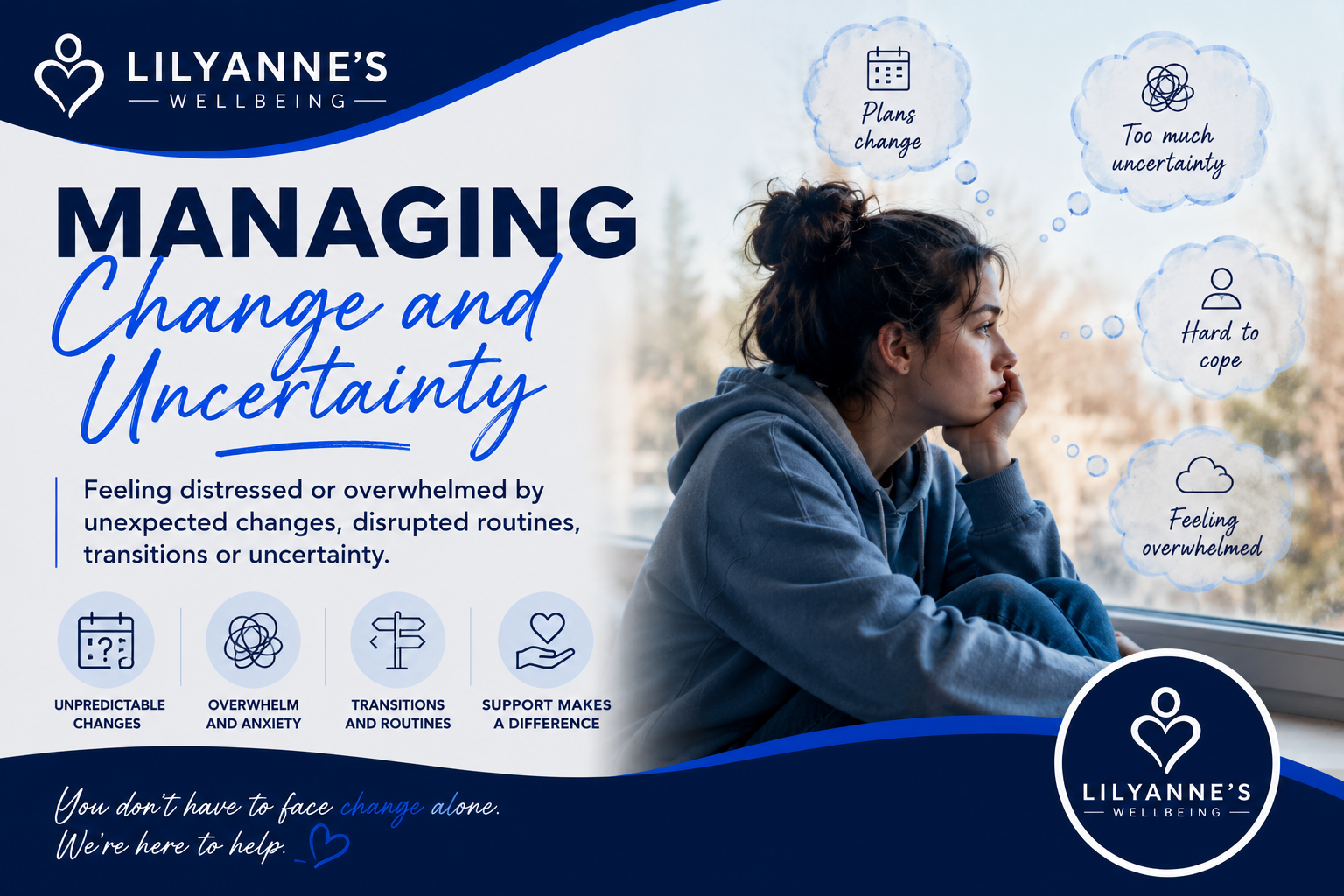
A change of plan might seem small to somebody else.
An appointment moves. Someone arrives later than expected. A familiar routine changes. Plans are cancelled. Something happens without warning.
For an autistic person, changes like these can sometimes feel much bigger than the situation appears from the outside.
You may have spent time mentally preparing for what was going to happen, working through the details and creating a sense of predictability. When something suddenly changes, that preparation disappears.
The result can be anxiety, frustration, confusion, overwhelm or a feeling that everything has become difficult to manage.
At LilyAnne’s Wellbeing, we understand that managing change isn’t simply about being told to “go with the flow”. Sometimes predictability provides the structure and security that makes everyday life manageable.
Why Can Change Feel So Difficult?
Knowing what is going to happen can provide a sense of stability.
A routine can reduce the number of decisions you need to make. Familiar environments can mean knowing what sensory experiences to expect. Plans can provide time to mentally prepare for conversations, journeys, activities and transitions.
When something changes unexpectedly, you’re suddenly dealing with information you hadn’t prepared for.
Instead of simply moving from one plan to another, your mind may need time to process that the original plan is no longer happening before it can begin adjusting to the new one.
That transition can require significant energy.
What Can Difficulty With Change Look Like?
Everybody experiences change differently.
For some autistic people, difficulties around change and uncertainty might include:
- Feeling anxious when plans aren’t confirmed
- Becoming distressed when plans suddenly change
- Needing to know what will happen in advance
- Finding last-minute arrangements difficult
- Struggling when familiar routines are interrupted
- Feeling overwhelmed when appointments are cancelled or moved
- Needing additional information before visiting somewhere unfamiliar
- Finding transitions between activities difficult
- Repeatedly thinking about an upcoming event
- Asking questions to understand exactly what will happen
- Feeling uncomfortable when there isn’t a clear plan
- Becoming upset when something happens differently from how you expected
- Needing time to process new information
- Finding unexpected visitors or phone calls overwhelming
- Struggling when significant life changes happen
These reactions aren’t necessarily somebody being difficult, controlling or unwilling to compromise.
There may be a genuine need for additional predictability and processing time.
When You’ve Already Prepared for the Plan
Sometimes the hardest part of a change isn’t the new plan itself.
It’s letting go of the one you’d already prepared for.
Imagine you’ve spent the morning preparing for an appointment at 2pm.
You’ve thought about when you’ll leave, how you’ll get there, where you’ll park, who you’ll speak to, what you’ll say and approximately when you’ll get home.
Then the appointment is suddenly moved to another day.
Someone else might think:
“That’s fine. I’ll just go tomorrow.”
But your mind may still be prepared for today.
You may have structured your entire day around that appointment. You may have already managed anxiety about attending it. You might have changed what you were doing before and afterwards to make it manageable.
The appointment hasn’t simply moved.
The structure you’d built around your day has changed too.
Uncertainty Can Be Exhausting
Change doesn’t always involve something actually happening.
Sometimes not knowing is the difficult part.
Waiting for an answer.
Not knowing what time somebody is arriving.
Waiting for an appointment date.
Being told “we’ll see what happens”.
Knowing something is changing but not knowing exactly what the new situation will look like.
Uncertainty can leave your mind trying to prepare for multiple possibilities at once.
What if this happens?
What if that happens instead?
What am I supposed to do if the plan changes?
This constant mental preparation can become exhausting.
For somebody already managing sensory demands, social communication, executive functioning and everyday responsibilities, uncertainty can add another significant layer of pressure.
Bigger Life Changes
Not every change is a cancelled appointment or disrupted routine.
Sometimes life changes completely.
Starting or leaving education, changing jobs, moving home, relationship changes, becoming a parent, experiencing bereavement or receiving an autism diagnosis can all involve significant transitions.
Even positive changes can feel overwhelming.
You can be excited about something and still find the transition difficult.
Those feelings don’t contradict each other.
A new job might be something you’ve wanted for years while still bringing unfamiliar people, routines, environments and expectations.
Moving into a new home might be exciting while also meaning losing the familiarity of the place where you previously felt comfortable.
Understanding this can remove some of the pressure to feel the way you think you’re “supposed” to feel about change.
Creating More Predictability
We can’t remove every unexpected change from life.
But we can sometimes make uncertainty easier to manage.
Having clear information can help.
Instead of saying:
“We’ll do it later.”
It may be more useful to explain approximately when “later” means.
If something has changed, explaining what has changed, what hasn’t changed and what will happen next can provide reassurance.
Visual schedules, calendars, written plans, reminders and step-by-step information can also help some people understand what to expect.
Where possible, giving advance notice of changes allows additional processing time.
The aim isn’t to create a world where nothing ever changes.
It’s to reduce unnecessary uncertainty.
Having a Backup Plan
For some people, knowing what will happen if something changes can make uncertainty more manageable.
For example:
“If the appointment is cancelled, we’ll come home and rearrange it.”
“If the restaurant is too busy, we’ll go somewhere quieter.”
“If the train is cancelled, we’ll take the next one.”
A backup plan can reduce the number of unknowns your mind feels it needs to solve.
It doesn’t mean every possibility needs to be planned.
Sometimes simply knowing there is another option can make the original situation feel safer.
Give Yourself Time to Process
You don’t always have to respond to a change immediately.
Sometimes you need time for your mind to catch up.
If possible, pause before making another decision.
Write down the new information.
Ask questions.
Take some time somewhere quieter.
Return to the situation when you’ve had an opportunity to process what’s changed.
Other people may adjust quickly.
That doesn’t mean you have to process change at the same speed.
When Change Leads to Overwhelm
Sometimes an unexpected change can be the final demand in an already difficult day.
You may already be managing sensory overload, social interaction, work, education, relationships or the exhaustion associated with masking.
Then something changes.
To somebody else, your reaction might appear disproportionate to what happened.
But they’re seeing the final change — not everything that came before it.
Understanding the wider picture is important.
Instead of asking:
“Why are you so upset about this?”
It can be more helpful to ask:
“What would help make this feel more manageable?”
Support That Works With You
At LilyAnne’s Wellbeing, we recognise that managing change isn’t about forcing yourself to become comfortable with uncertainty.
It’s about understanding what makes situations difficult and finding strategies that work for you.
Our autism, neurodiversity, counselling, listening and wellbeing support can provide space to explore routines, transitions, anxiety, sensory overwhelm, masking and the everyday demands you’re experiencing.
You don’t need to justify why something feels difficult simply because somebody else finds it easy.
Sometimes knowing what’s coming next provides the security you need to manage everything else.
And when life doesn’t go to plan, having the right understanding and support around you can make adapting to what happens next feel a little more manageable.
LilyAnne’s Wellbeing is here to listen, understand and support you without judgement.
