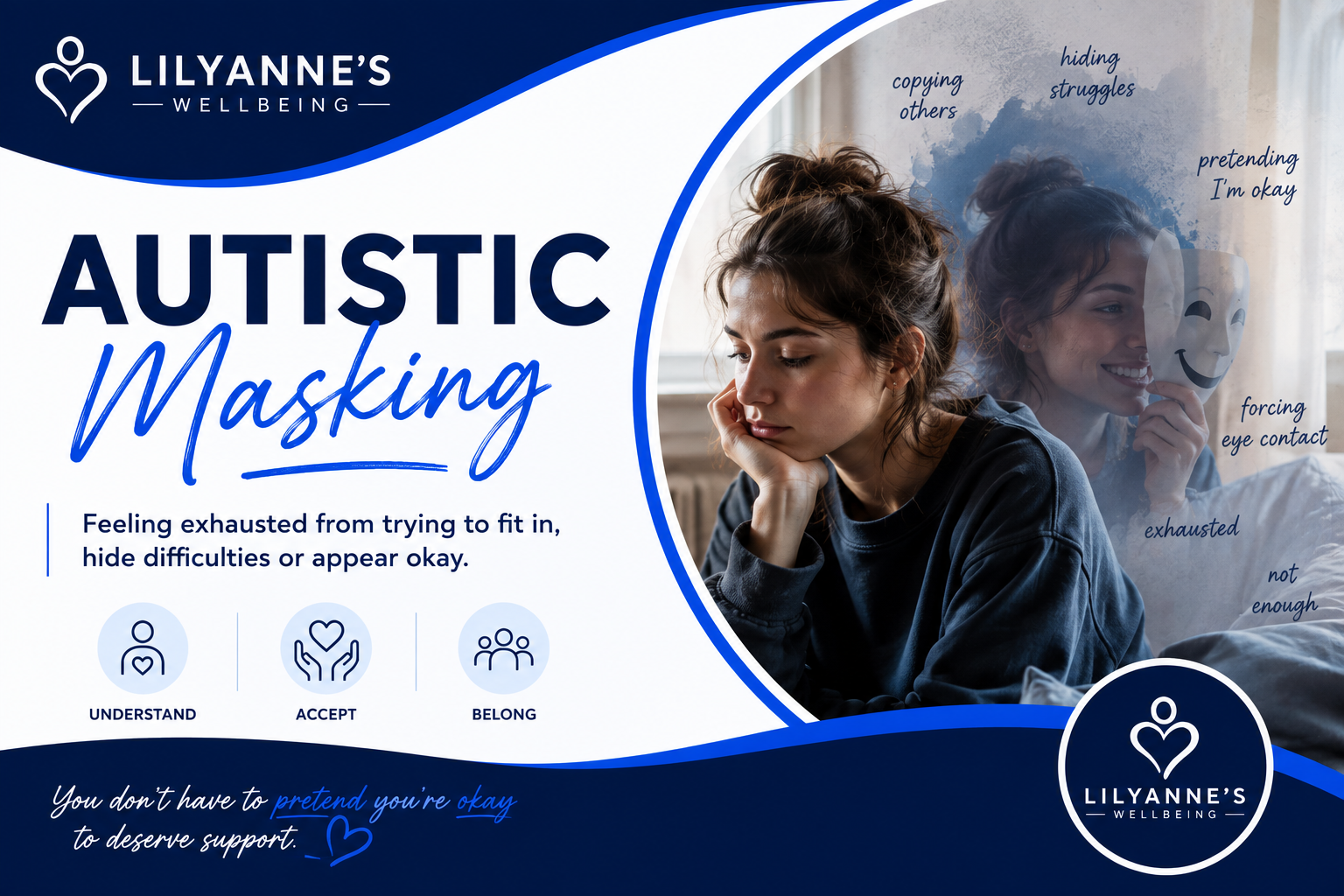
Sometimes looking like you’re coping on the outside can hide just how much effort it is taking on the inside.
You might carefully monitor how you speak, force yourself to make eye contact, suppress movements that help you regulate, copy other people’s behaviour or hide when sounds, lights, crowds or social situations are becoming overwhelming.
You get through the conversation. You finish the working day. You smile when you’re expected to smile.
To everybody else, you may appear completely fine.
But afterwards, you can feel exhausted.
This experience is often described as autistic masking — hiding, suppressing or changing natural autistic behaviours and responses in order to fit into social expectations, avoid negative reactions or appear more neurotypical.
At LilyAnne’s Wellbeing, we recognise how exhausting it can be when so much of your energy is spent trying to make other people believe you’re okay.
What Is Autistic Masking?
Autistic masking, sometimes called camouflaging, can involve consciously or unconsciously changing the way you naturally communicate, behave or respond to your environment.
For some autistic people, masking begins very early in life.
You may notice that other people communicate differently and begin copying them. You learn which behaviours attract criticism and which receive approval.
Over time, you develop strategies for navigating situations that weren’t necessarily designed around the way you experience the world.
Eventually, some of those strategies can become so automatic that you may not realise you’re masking at all.
What Can Autistic Masking Look Like?
There isn’t one way that autistic masking looks.
It can include:
- Forcing or carefully managing eye contact
- Rehearsing conversations before they happen
- Planning what you’re going to say
- Copying other people’s facial expressions or body language
- Imitating how other people speak
- Suppressing stimming or repetitive movements
- Trying not to talk extensively about particular interests
- Hiding sensory discomfort
- Staying in overwhelming environments longer than feels manageable
- Pretending to understand social cues
- Laughing because everybody else is laughing
- Developing scripts for common social situations
- Watching other people closely to work out how you’re expected to behave
- Hiding confusion or distress
- Pretending you’re comfortable when you’re overwhelmed
- Waiting until you’re alone before releasing emotions
- Saying you’re fine when you’re anything but fine
Some people become incredibly skilled at masking.
That doesn’t mean it isn’t costing them something.
“You Don’t Look Autistic”
One of the consequences of masking is that other people may not recognise how much somebody is struggling.
A person might communicate confidently because they’ve rehearsed the interaction beforehand.
They might maintain eye contact because they’ve spent years teaching themselves to do it.
They may manage an entire day at work, school or in social situations before getting home and having absolutely nothing left.
People see the performance.
They don’t necessarily see the preparation, anxiety, sensory overload or recovery afterwards.
This can contribute to autistic people having their experiences dismissed because they don’t fit somebody else’s expectation of what autism is supposed to look like.
Being able to mask does not make somebody’s autistic experience less valid.
Why Do Autistic People Mask?
Masking can develop for many different reasons.
For some people, it can be a response to being criticised, bullied, excluded or treated differently.
Someone may repeatedly have been told to:
“Look at me when I’m talking to you.”
“Stop doing that.”
“Don’t be so sensitive.”
“Why are you being rude?”
“Just join in.”
“You need to act your age.”
Over time, a person can learn that showing their natural responses risks attracting unwanted attention.
Masking can therefore become a way of navigating environments where being yourself hasn’t always felt accepted or understood.
It isn’t simply a habit that somebody can necessarily switch off.
For some people, it has been a form of self-protection.
The Exhaustion Behind Masking
Imagine having to consciously think about things that other people may do automatically.
Where should I look?
How long should I make eye contact?
Was that a joke?
Should I laugh?
Am I talking too much?
Am I talking too little?
What should my face be doing?
Is everybody else uncomfortable?
Can they tell I’m overwhelmed?
Now imagine doing that while also processing conversation, sensory information, work, education, relationships and everyday responsibilities.
That can require an enormous amount of mental and emotional energy.
Once the person reaches somewhere they feel safe, the mask may begin to drop.
They might become quiet, need to be alone, stim more freely, struggle to communicate, feel emotionally overwhelmed or simply need significant time to recover.
What looks like somebody “coping perfectly well” during the day may therefore tell you very little about how much that day actually cost them.
Masking and Autistic Burnout
When somebody spends long periods masking while also managing sensory, social and everyday demands, exhaustion can build.
For some autistic people, prolonged demands can contribute to autistic burnout.
This can involve profound exhaustion, reduced capacity to manage everyday activities and finding things that were previously manageable significantly harder.
The answer isn’t simply to become better at masking.
Sometimes the more important question is:
What is requiring this person to mask so much in the first place?
Reducing unnecessary demands, creating more accommodating environments and allowing somebody to communicate or regulate in ways that work for them can be much more meaningful.
Masking and Identity
Masking can also affect someone’s sense of identity.
If you’ve spent years watching other people and adapting yourself depending on who you’re around, you may eventually wonder which version is actually you.
You might ask yourself:
What do I actually enjoy?
What makes me comfortable?
Which behaviours are natural to me?
What have I learned to suppress?
Who am I when nobody is watching?
For people who recognise they are autistic later in life, understanding masking can sometimes make years of experiences suddenly make more sense.
That realisation can bring relief.
It can also bring sadness or frustration when recognising how much effort has gone into trying to fit expectations that weren’t designed around you.
Creating Spaces Where Masking Isn’t Expected
Supporting an autistic person doesn’t mean teaching them how to appear less autistic.
It means considering what might help them feel comfortable enough that they don’t need to constantly hide their needs.
That could mean accepting different forms of communication, allowing movement or stimming, reducing unnecessary sensory demands, providing clearer information, allowing additional processing time or understanding that eye contact isn’t required for somebody to be listening.
It can also mean simply believing somebody when they tell you they’re overwhelmed — even when they don’t outwardly look distressed.
Small changes in understanding can remove significant amounts of pressure.
You Don’t Have to Pretend You’re Okay
At LilyAnne’s Wellbeing, you don’t need to perform wellbeing.
You don’t have to force eye contact, communicate in a particular way or pretend you’re comfortable when you’re struggling.
Our autism, neurodiversity, counselling, listening and wellbeing support provides space to explore masking, identity, sensory overwhelm, relationships, burnout and the everyday challenges you may be experiencing.
Support shouldn’t be about changing an autistic person into somebody who appears more neurotypical.
It should be about understanding the individual, recognising what they need and helping create a life where they don’t have to spend so much energy hiding who they are.
You shouldn’t have to appear okay to deserve support.
LilyAnne’s Wellbeing is here to listen, understand and support you without judgement.
