
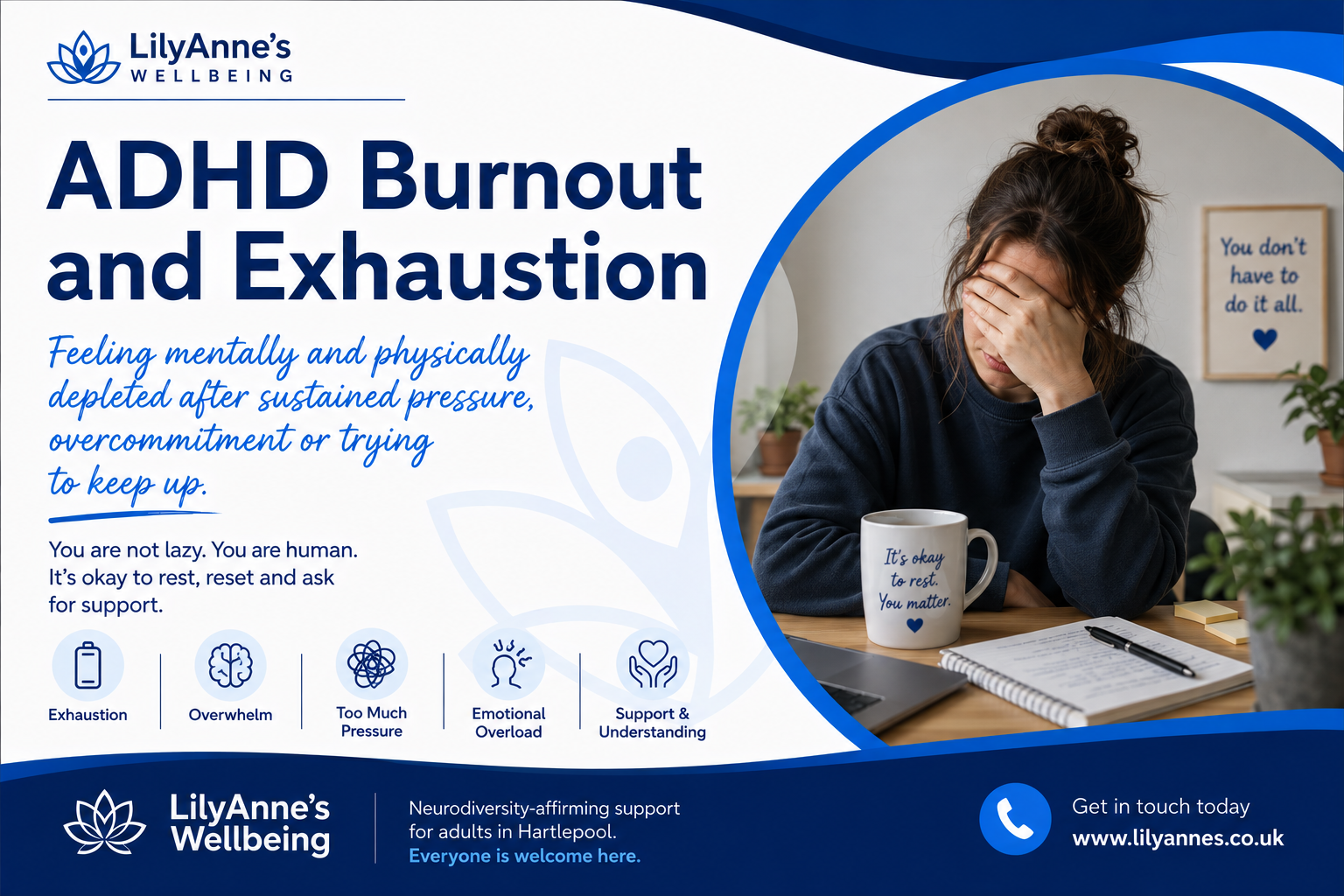
For a long time, you might appear to be coping.
You go to work. You manage appointments. You respond to messages. You look after other people. You meet deadlines. You keep saying yes.
From the outside, everything can look fine.
But underneath, maintaining that level of functioning can take an enormous amount of energy.
Eventually, you may reach a point where there simply doesn’t seem to be anything left.
You feel mentally exhausted, physically depleted and unable to keep doing things that you previously managed.
For some people with ADHD, this experience is described as ADHD burnout.
At LilyAnne’s Wellbeing, we recognise that constantly trying to keep up with everyday expectations can become exhausting. Support isn’t about pushing you to become more productive. Sometimes it’s about understanding what’s draining your capacity and finding a more sustainable way forward.
What is ADHD burnout?
ADHD burnout isn’t currently a standalone medical diagnosis. The term is commonly used to describe a period of significant mental, emotional and physical exhaustion associated with prolonged demands and the effort involved in managing life with ADHD.
It can happen when someone has been operating beyond their capacity for too long.
That might involve:
- Constantly trying to stay organised
- Managing competing responsibilities
- Working intensely to meet deadlines
- Overcommitting
- Masking or hiding difficulties
- Trying to meet neurotypical expectations
- Managing executive functioning challenges
- Dealing with sensory or emotional overload
- Repeatedly pushing through exhaustion
- Not having enough genuine recovery time
Eventually, the strategies that normally keep everything moving can become harder to maintain.
What can ADHD burnout feel like?
Burnout can look different for different people.
For some, it’s overwhelming exhaustion.
For others, it’s feeling unable to start even basic everyday tasks.
You might notice:
Extreme tiredness
You can sleep or rest and still feel mentally and physically exhausted.
Executive functioning becoming harder
Planning, organising, remembering things and starting tasks may become significantly more difficult.
Loss of motivation
Things you normally care about can suddenly feel impossible to begin.
Difficulty concentrating
Your thoughts might feel foggy, scattered or unusually slow.
Emotional overwhelm
Small frustrations may trigger disproportionately strong emotional responses because your capacity is already stretched.
Withdrawal
Messages go unanswered. Plans get cancelled. Socialising feels exhausting and you may want to shut yourself away from demands.
Reduced tolerance for everyday demands
Noise, interruptions, decisions and responsibilities that you could previously manage may suddenly feel overwhelming.
Feeling unable to “keep up”
You might watch other people continuing with everyday life and wonder why everything seems to require so much more effort from you.
The cycle of pushing and crashing
One pattern that some people with ADHD recognise is a cycle of overdoing things followed by exhaustion.
You have lots of energy or motivation.
You agree to several things.
You work intensely.
You stay up late finishing something.
You neglect breaks because you’re finally being productive.
You push yourself to catch up with everything you’ve fallen behind on.
For a while, it feels like you’re getting somewhere.
Then you crash.
Suddenly, tasks that felt manageable a few days earlier feel impossible.
You rest just enough to function again — and then immediately begin trying to catch up.
The cycle starts again.
Over time, these repeated periods of pushing beyond your limits can become increasingly difficult to recover from.
“But I haven’t done enough to be this tired”
This thought can be particularly difficult.
You might look at your day and think:
“Why am I exhausted? I haven’t even done that much.”
But effort isn’t always visible.
Remembering what needs doing requires effort.
Managing distractions requires effort.
Switching between tasks requires effort.
Trying to appear organised when you’re struggling requires effort.
Managing emotions requires effort.
Masking difficulties requires effort.
Trying to work out where you’ve put something for the fifth time that day requires effort.
And constantly criticising yourself for finding these things difficult uses energy too.
What looks like an ordinary day from the outside can involve an enormous amount of mental processing.
Overcommitment can become part of the problem
Sometimes ADHD can make saying yes very easy.
A new opportunity sounds exciting.
Someone needs help.
A project feels interesting.
You genuinely believe you’ll have enough time.
Then everything arrives at once.
The problem isn’t necessarily that you don’t care about your commitments.
Often it’s the opposite.
You care deeply and don’t want to disappoint anybody.
So instead of reducing your responsibilities, you push yourself harder.
Learning to recognise your actual capacity — rather than the capacity you wish you had — can be an important part of preventing repeated exhaustion.
Rest isn’t something you have to earn
When you’re accustomed to measuring your day by what you’ve achieved, resting can feel uncomfortable.
You sit down, but your mind immediately begins listing everything you should be doing.
So you’re technically resting while mentally criticising yourself for resting.
That’s not particularly restorative.
Recovery can involve giving yourself permission to temporarily reduce demands.
Not everything needs fixing today.
Not every message requires an immediate response.
Not every invitation needs a yes.
And sometimes the most productive thing you can do is recognise that your capacity has been reached.
Making everyday demands smaller
When you’re exhausted, looking at everything you’ve fallen behind on can make the situation worse.
Instead of asking:
“How am I going to sort my whole life out?”
try:
“What would make today slightly easier?”
That might mean:
- Choosing one priority rather than ten
- Breaking tasks into very small steps
- Using reminders instead of relying on memory
- Preparing simple meals rather than expecting yourself to cook
- Cancelling something non-essential
- Asking somebody for help
- Reducing unnecessary decisions
- Creating quiet time without demands
- Putting something off deliberately rather than feeling guilty that it hasn’t happened
When your capacity is reduced, expectations sometimes need to reduce too.
Look at what’s draining you, not just how to cope with it
We often respond to burnout by searching for ways to become more resilient.
But sometimes the better question is:
What is requiring so much resilience in the first place?
Is your workload realistic?
Are you constantly masking?
Have you taken on too many responsibilities?
Are you saying yes because you’re frightened of disappointing people?
Are you getting genuine downtime?
Are you trying to maintain organisational systems that don’t work for you?
Are you comparing yourself with people whose circumstances are completely different?
Coping strategies can help, but sometimes something about the demands themselves needs to change.
Burnout doesn’t mean you’ve failed
When you’re used to functioning at a certain level, suddenly being unable to maintain it can affect your confidence.
You may think:
“I used to manage this.”
“Why can’t I just get on with things?”
“Everyone else seems to cope.”
But exhaustion isn’t a character flaw.
If you’ve spent months or years pushing yourself beyond what is sustainable, your mind and body may be telling you something important.
Support should not simply help you return to exactly the same circumstances that exhausted you.
It can also help you understand what needs to be different.
How LilyAnne’s Wellbeing can help
At LilyAnne’s Wellbeing, we provide compassionate, neurodiversity-friendly support for adults experiencing ADHD-related overwhelm, burnout and exhaustion.
We can help you explore:
Burnout and exhaustion — understanding what’s been draining your mental and physical capacity.
Executive functioning — practical support with planning, organisation, routines and everyday demands.
Overcommitment and boundaries — recognising your capacity and becoming more comfortable saying no when you need to.
Emotional wellbeing — having somewhere safe to talk about frustration, guilt, overwhelm or feeling unable to cope.
Everyday strategies — finding realistic ways of reducing demands and making daily life more manageable.
Our wider support includes one-to-one counselling, listening support, neurodiversity support, peer support, advice, resources and signposting.
You don’t need to arrive with everything neatly explained.
Sometimes:
“I’m exhausted and I don’t know how to keep doing this”
is enough to begin the conversation.
You don’t have to keep pushing until you crash
There will always be things that need doing.
But constantly sacrificing your wellbeing to keep up isn’t sustainable.
You are allowed to recognise that something is too much.
You are allowed to change your expectations.
You are allowed to ask for help.
And you are allowed to rest without first proving that you’ve done enough to deserve it.
ADHD support shouldn’t be about forcing yourself to function like everybody else.
It should help you understand how you function best and build a life that doesn’t repeatedly leave you completely depleted.
LilyAnne’s Wellbeing is here to listen, understand and provide practical support when ADHD, overwhelm and everyday demands become too much.
