
Life doesn’t always go the way we expected.
Relationships change. Confidence can disappear. Families go through difficult periods. Work becomes overwhelming. We question who we are, where we’re going and whether we’re making the right decisions.
Sometimes there isn’t a diagnosis, a crisis or one particular event we can point to.
Things just feel difficult.
At LilyAnne’s Wellbeing, we believe you don’t need to reach breaking point before you’re allowed to ask for support.
Sometimes you simply need somewhere safe to talk, make sense of what’s happening and work out what comes next.
What do we mean by life challenges?
Life challenges can be anything that affects your emotional wellbeing or makes everyday life harder to manage.
They can be significant events such as a relationship ending, losing a job or experiencing a major change.
But they can also be quieter struggles.
Feeling stuck.
Losing confidence.
Not knowing what you want anymore.
Feeling disconnected from the people around you.
Finding yourself constantly putting everyone else’s needs before your own.
Or simply recognising that you don’t feel like yourself at the moment.
These experiences matter too.
Relationships
Relationships can bring some of the greatest happiness into our lives, but they can also be a significant source of worry, uncertainty and emotional pain.
You may be experiencing difficulties with a partner, family member, friend or colleague.
Perhaps communication has broken down. Maybe you’re struggling to establish boundaries or finding yourself repeatedly caught in the same patterns.
Sometimes we can become so focused on keeping a relationship together or keeping everybody else happy that we stop considering what we need.
Having somewhere independent and non-judgemental to talk can help you explore what’s happening without somebody immediately telling you what you should do.
Support isn’t about making decisions for you.
It’s about helping you understand your feelings, recognise patterns and feel more confident making your own choices.
Confidence and self-esteem
Confidence can be affected by many things.
Criticism, rejection, difficult relationships, bullying, workplace experiences, comparison with others or simply years of feeling as though you’re never quite good enough can gradually change the way you see yourself.
You might:
- Constantly doubt your decisions
- Compare yourself with other people
- Find it difficult to accept compliments
- Avoid opportunities because you’re worried about failing
- Feel uncomfortable speaking up for yourself
- Put other people’s needs before your own
- Seek reassurance that you’ve done the right thing
- Focus on your mistakes while overlooking everything you do well
Low confidence doesn’t always disappear because somebody tells you to “believe in yourself”.
Building confidence can take time.
It can begin with understanding where those beliefs about yourself came from and learning to challenge the ones that no longer serve you.
Identity and understanding yourself
Who am I?
It sounds like a simple question, but sometimes it can be incredibly difficult to answer.
Our identity can be shaped by relationships, family, culture, work, parenthood, neurodiversity, experiences and the roles we’ve taken on throughout our lives.
There may be periods when you begin questioning things you previously felt certain about.
You might receive an autism or ADHD diagnosis later in life and start looking at your past experiences differently.
You may leave a long-term relationship and wonder who you are outside it.
Your children might grow older and need you differently.
Your career might change.
Or perhaps you’ve spent so much time adapting yourself for everybody around you that you’ve lost sight of what you actually want.
Exploring identity isn’t selfish.
Understanding yourself can help you make choices that better reflect your needs, values and the person you want to become.
Coping with change
Even positive change can be difficult.
Starting a new job, moving home, beginning a relationship, becoming a parent or receiving an opportunity you’ve wanted for years can still bring uncertainty.
Other changes happen without our permission.
Relationship breakdowns.
Redundancy.
Bereavement.
Financial difficulties.
Changes within our families.
Health concerns.
Unexpected responsibilities.
When life suddenly looks different, it can take time for our emotions to catch up.
You don’t have to immediately “look on the bright side”.
Sometimes adjusting means acknowledging that something has changed and giving yourself space to understand what that means for you.
When everything feels like too much
Sometimes it isn’t one big thing.
It’s everything at once.
Work is stressful.
There’s tension at home.
You’ve forgotten an appointment.
Money is tight.
Somebody needs something from you.
You’ve got messages you haven’t answered.
The house needs sorting.
And then something seemingly tiny happens — and suddenly you’re overwhelmed.
The small thing wasn’t necessarily the problem.
It was simply the final demand when you were already carrying too much.
Recognising when your capacity is becoming stretched can help you respond before everything becomes unmanageable.
Ask yourself:
What genuinely needs my attention today?
Not everything needs to be solved immediately.
Everyday wellbeing matters
Wellbeing isn’t about being happy all the time.
It isn’t expensive retreats, perfect morning routines or pretending difficult things aren’t happening.
Sometimes wellbeing is much simpler.
Getting enough rest.
Talking to somebody.
Getting outside.
Eating something.
Setting a boundary.
Doing something you enjoy without feeling guilty.
Asking for help.
Cancelling something when you’ve taken on too much.
Or giving yourself permission to have a difficult day without deciding that everything is going wrong.
Small things matter.
You don’t need a diagnosis to ask for support
One of the biggest misconceptions about emotional support is that something has to be seriously wrong before you can access it.
It doesn’t.
You might not know exactly what’s bothering you.
You may struggle to explain why you’ve been feeling different.
You might simply know:
“I’m not coping as well as I usually do.”
That’s enough reason to talk.
Early support can help prevent everyday challenges from becoming increasingly overwhelming.
How LilyAnne’s Wellbeing can help
At LilyAnne’s Wellbeing, we provide a welcoming, non-judgemental environment where you can talk about what’s happening in your life.
Our support around life challenges can include:
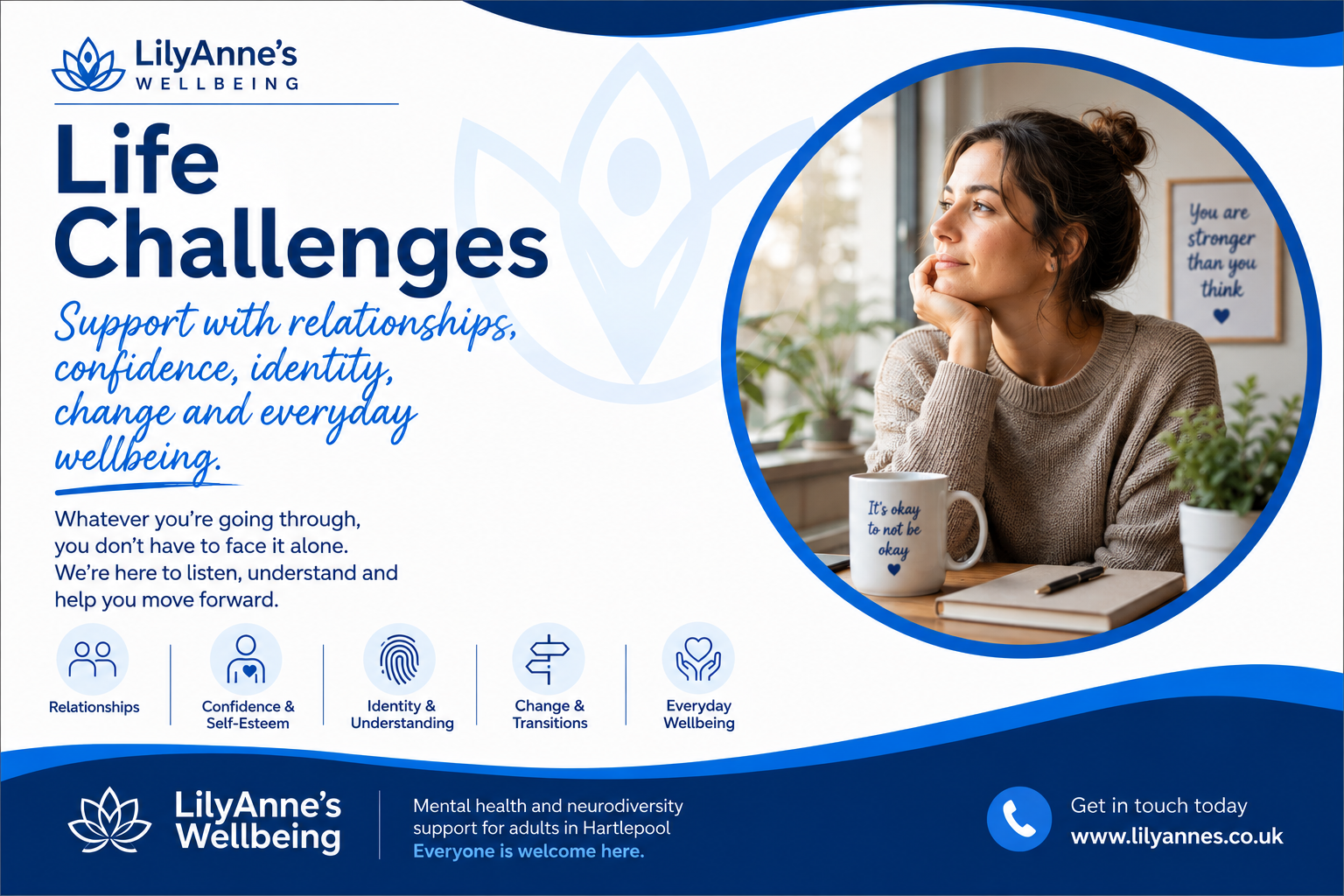
Relationships — exploring communication, boundaries, difficult relationships and changing circumstances.
Confidence — helping you understand self-doubt, recognise your strengths and gradually rebuild your confidence.
Identity — providing space to explore who you are, what matters to you and how experiences or neurodiversity may have shaped your understanding of yourself.
Change — supporting you through transitions, uncertainty and unexpected changes in your life.
Everyday wellbeing — helping you recognise what’s affecting your wellbeing and identify realistic ways of making things feel more manageable.
Depending on what you need, we can also provide one-to-one counselling, listening support, neurodiversity support, peer support, advice, resources and signposting.
You are allowed to ask for help before things become unbearable
You don’t need to justify needing support by proving that somebody else would find your situation difficult.
If something is affecting you, it matters.
There isn’t a competition for who has the hardest life.
Sometimes having somebody listen without judgement can help you understand something you’ve been carrying around for months.
Sometimes you need practical support.
Sometimes you need help finding your confidence again.
And sometimes you simply need somewhere you can say:
“I’m struggling.”
without immediately having to follow it with:
“…but I’m fine.”
Whatever life looks like for you right now, you don’t have to work through everything by yourself.
LilyAnne’s Wellbeing is here to listen and support you through relationships, confidence, identity, change and the everyday challenges that life can bring.
